

5 Ways to Leverage Your Coach
by Rhandy Siordia, Senior Associate, Achievement Operations
Tách!
In as much time as it takes you to snap your fingers, you have become a student again. It’s odd…you could have sworn that only a moment ago you were the teacher — leading discussion, imparting wisdom, guiding, correcting. But now, you’ve just dismissed your kids and you’re sitting down for a meeting with your coach. You have a to-do list as long as your arm, so a meeting about abstract-sounding strategies might not be your top priority at the moment. We’ve all been there. Aristotle always said the best way to become a strong teacher is to scribble a few notes while your coach makes suggestions, passing time until you can move on to that to-do list, right?
Chắc chắn là không.
Taking a passive approach to the coaching process is side-stepping an opportunity to take advantage of the individualized development and support that coaching provides. When I began my first year of teaching, I didn’t know what to expect when I was assigned a “teacher coach.” But over time I’ve gathered a few insights that I hope will prove useful to new and seasoned teachers alike.
1. Ask Questions
Continually improving your practice is tough—thankfully you have a coach who is there to help. It’s easy to focus on internalizing “what” your coach is advising you to do and “how” your coach is advising you to do it. It’s easy to become preoccupied with the strategies and resources provided to us, looking for a quick fix for what we are trying to accomplish in the classroom. However, this approach neglects what I consider to be the most important, yet underrated part—the “why.”
“Why,” might you ask? Investment. To motivate students, a teacher should be prepared to give them a reason to care. In the same way, you can increase your own investment by asking your coach tại sao she suggests certain approaches or how a professional development will translate to your specific classroom. Maintaining an open dialogue with your coach sets a strong foundation for reflection, improvement, and investment in the future.
2. Be open to feedback. But stay true to your own vision.
Unlike the hoards of materials and resources teachers love sharing with each other, there is one very important part of your classroom that isn’t as easy to share—your vision. When gathering feedback from your coach (or whomever, for that matter), I’ve found that it’s most helpful when you consider it within the context of your vision for của bạn classroom.
For a given piece of feedback, you may ask yourself, “How can I adapt this so it will have the greatest impact given my classroom culture, the differing learning goals of my students, etc.?” There’s an endless list of new approaches to virtually anything in the classroom. It’s important to keep it in context.
Even with more direct feedback, have a conversation about how it aligns with your classroom vision with your coach. This is a great opportunity to thought partner with your coach (see #4) and an opportunity to exercise your intellectual vitality, a key characteristic of a true lifelong learner.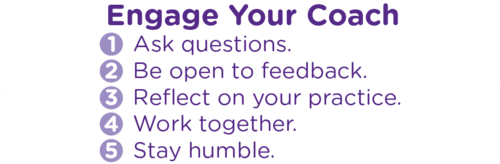
3. Reflect on your own practice regularly.
Được rồi—bạn đã suy nghĩ kỹ về khoản đầu tư và tác động của các bài học, đồng thời bạn đã tích hợp phản hồi với tầm nhìn của mình. Vui vì mọi thứ đã kết thúc… đã đến lúc ăn mừng chưa?
Khoan đã. Tiếp nhận và tích hợp phản hồi chỉ mới là bộ phận of the process. In order to learn and grow from both shortcomings and successes, it is crucial to build a habit of engaging in a reflective, evaluative practice of some kind. Reflecting on feedback from my coach, data or past lessons allows me to make informed decisions when building my next plan of action.
Điều này có thể dưới hình thức sửa đổi kế hoạch của tuần tới, đặt ra các mục tiêu mới cho học sinh của tôi, hoặc cho bản thân tôi, hoặc thay đổi trình tự nội dung được trình bày trong lớp. Sử dụng sự suy ngẫm để tạo ra các kết quả có thể đo lường được (cho bản thân bạn hoặc cho học sinh của bạn) là một cách hữu hình, mạnh mẽ để thúc đẩy sự phát triển của bạn; đồng thời, huấn luyện viên của bạn sẽ đánh giá cao sự thấu đáo và chủ động của bạn!
4. Work together.
Two heads are better than one. By sharing ideas and thinking through possibilities collaboratively, we can improve approaches to instruction or reflect and set next steps.
In fact – ready for a plot twist? In many ways, coaches are students too! The way I see it, a coach that will have the most meaningful impact is the coach who operates as a lifelong learner as well. Your coach should welcome, implement and reflect upon feedback in a similar way as you do. The underlying premise here is one that we, as teachers, are all too familiar with—no matter who you are or what you do, you should never be “done” learning.
Tiếp tục nâng cao tiêu chuẩn và tiếp tục phát triển.
5. Đừng tự cao tự đại nữa.
Nền tảng của mọi khía cạnh trong mối quan hệ giữa giáo viên và huấn luyện viên chính là sự khiêm tốn. Tất cả những điều trên—sự đầu tư, tiếp thu phản hồi, suy ngẫm, hợp tác—sẽ không thể đạt được nếu bạn không thừa nhận một thực tế rằng bạn have room for improvement. This process is undoubtedly more challenging for some than others. But to those that allow themselves to be vulnerable for the sake of improving and developing as a professional – the skills you develop through the coaching process will benefit both yourself and all the children whose lives you touch. Every single day.
Rhandy Siordia is the Senior Associate, Achievement Operations for Rocketship’s Network Support Team. Rhandy is a former founding teacher at Học viện Spark, located in the same community where he spent his first years of life. He graduated from University of California, Santa Barbara with a BA in Psychology.
Published on Tháng chín 10, 2015
Đọc thêm các câu chuyện về: Kinh nghiệm của giáo viên.

 Tiếng Việt
  English
  Español de México