
Joy, Honesty, and a Little Civil Disobedience: The real story behind the double-digit growth at Rocketship Rise
JaQuan Bryant, Principal, Rocketship Rise Academy
Recientemente, the fourth- and fifth-graders at Rocketship Rise Academy in Washington D.C. achieved something we are incredibly proud of: making double-digit leaps in proficiency in both math and ELA on the District of Columbia’s CAPE assessment. In education, seeing 3 to 5 percent growth is considered a strong year. Over the last two testing cycles, our students moved well past those standard benchmarks.
When you achieve that kind of growth, people ask for your playbook.
Part of that playbook is structural.
A significant piece of that playbook is structural. Rocketship Rise is a proud part of the national Rocketship Public Schools network, and we lean heavily on our proven educational model. Our intentional rotational schedule, personalized learning blocks, and rigorous, data-driven instruction give us a distinct advantage.
But the real magic happens when you partner that framework with deep, local, human connection. The real recipe behind our academic leap is how we reset the way we treat families, made student joy a non-negotiable, and turned our belief in students into concrete action.
The Prerequisite of Unshakable Belief
It’s easy to say we believe in our students, but belief without action is just a poster on a wall. If we truly believe our kids can achieve at the highest levels, our job is to actively remove the obstacles in their way.
Because our daily schedule gives us the flexibility to adapt in real time, I can be in the classrooms side-by-side with our teachers, figuring out what’s working and sparring over how to fix what isn’t. For example, we noticed a campus-wide trend: our kids were so eager to pick up their pencils and get to work that they were rushing through the actual thinking required to understand a complex task. Because we believe in their capacity for rigorous work, we didn’t just accept that as a quirk. I jumped in to coach teachers and leaders and even modeled lessons to address that specific gap.
We also have to walk the talk when it comes to building trust. I make it a priority to learn hundreds of student names in the first days of school. Recently, I greeted a student named Jiraya. His mom was shocked—he had only been here a week, but the principal already knew his name. That isn’t just a party trick; it is an academic strategy. Because Jiraya feels seen and safe, I can push him a little harder academically. He trusts us enough to take risks and make the mistakes that actual learning requires.
Parents as the Majority Stakeholders
We work in an era where trust in institutions is low. Honestly, many of the families we serve didn’t have great experiences when they were in school, and they carry that history with them. To build something real, we had to tear down the traditional walls between the school and the community.
Our core conviction is that parents are a child’s first and forever teacher. In this partnership, the family is the majority stakeholder.
We put evidence behind this partnership last year by completely changing how we communicate. We stopped providing generic updates and started having clear, consistent conversations: Here is exactly where your student started the year, here is where they are right now, and here are two specific things you can do at home to help. Instead of vague advice, we gave concrete tools to reinforce learning at home. Giving parents that agency had a profound impact on the trust they placed in us.
And because it is their space, parents are welcome on campus anytime.
Most importantly, when we drop the ball, I sit across from a parent, look them in the eye, and say, “We made a mistake, and I’m sorry. Here is exactly how we are going to fix it.” When families see accountability instead of defensiveness, the barriers fall.
Joy as Civil Disobedience
Beyond the academic assessments and the daily schedule, there is one metric that matters more than any test score: Do our kids actually want to be here?
In many ways, cultivating joy in our classrooms is an act of civil disobedience. We have to be honest that the American public school system, historically, was not built for Black and brown children to thrive. Pushing back against that means deliberately creating spaces where learning is joyful, where kids have fun, and where they see themselves as empowered scholars.
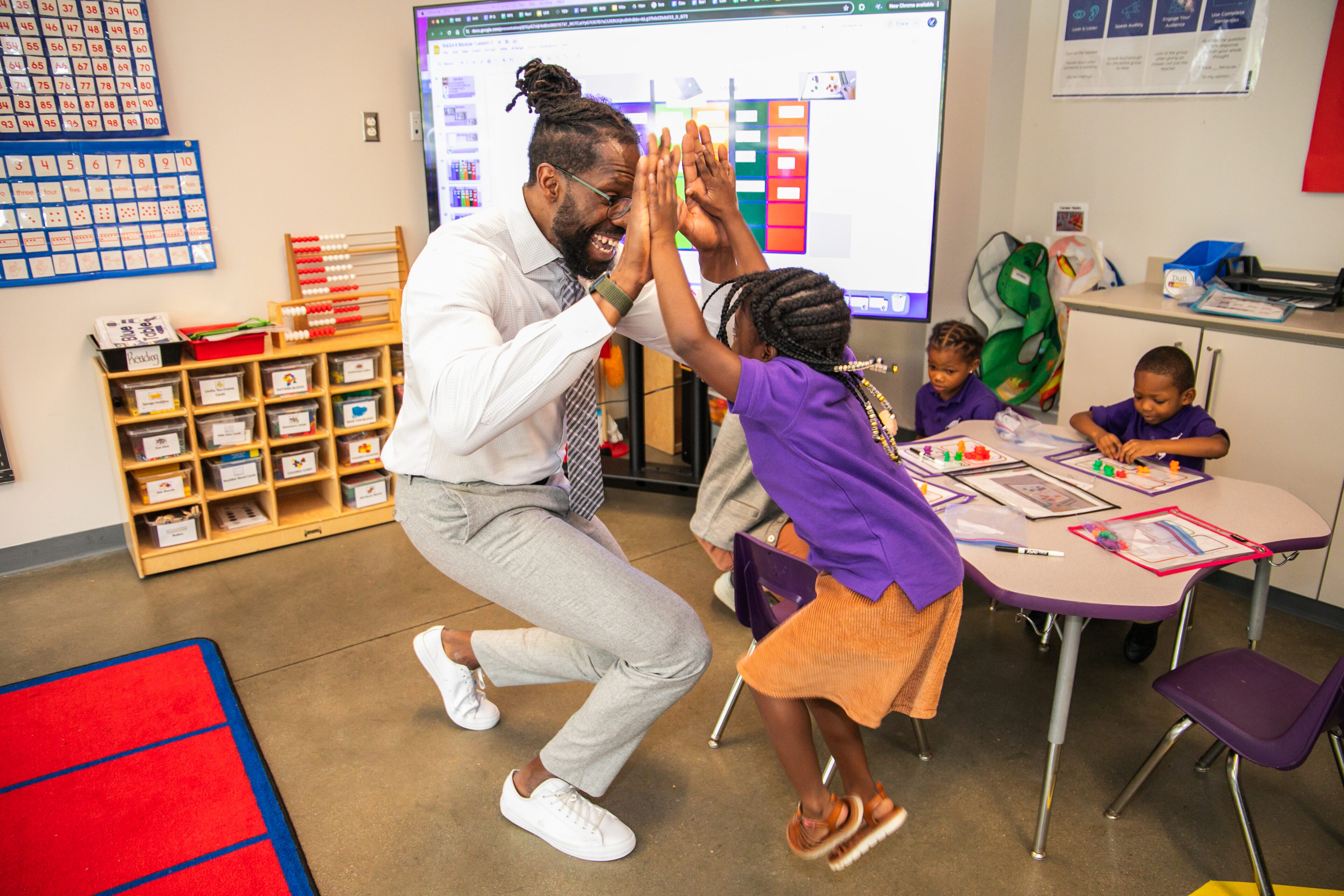
We track this joy just as closely as our academics. Before this school year even officially started, we hosted “Kinder Camp” for our pre-K and kindergarten students. At the end of the day, kids were literally crying because they didn’t want to leave. For our fifth graders—who are just hitting that natural phase of pre-teen angst—I recently assigned some very specific homework: write three to five sentences about exactly what would make school enjoyable for you.
I keep a letter on my wall from a mother whose son used to cry to avoid going to his previous school. After he transferred to Rise, the script flipped—he started waking his mom up early because he couldn’t wait to get to class. Even when the family moved further away, they kept making the drive because he wanted to be here. That intrinsic motivation is the exact reason our kids are succeeding academically.
The Cost of Caring
Stepping into school leadership required a profound realization: I have to invest in the adults in our building with the same intensity we give our kids. We aren’t just “staff”—we are a team doing deeply personal, incredibly hard work.
When you build a culture around intense human connection, the professional becomes personal. When a teacher is going through a family crisis, we don’t just send a sympathy card; teammates immediately step in to cover classes and share lesson plans so that person can step away without guilt. When a colleague struggles, it hurts the whole team. That shared empathy is the cost of authentic investment. You can’t fake it, and you can’t bypass it to get to the good stuff.
Double-digit test score growth is a fantastic milestone, and I am incredibly proud of the hard work our students and teachers put in to achieve it. But those CAPE scores are just the byproduct. The real achievement is the culture that produced them: a place defined by deep care, unapologetic joy, a powerfully supportive team, and an unshakable belief in what our kids can do every single day.
Published on octubre 20, 2026
Lea más historias sobre: Sin categoría.

 Español de México
 English
 Tiếng Việt