

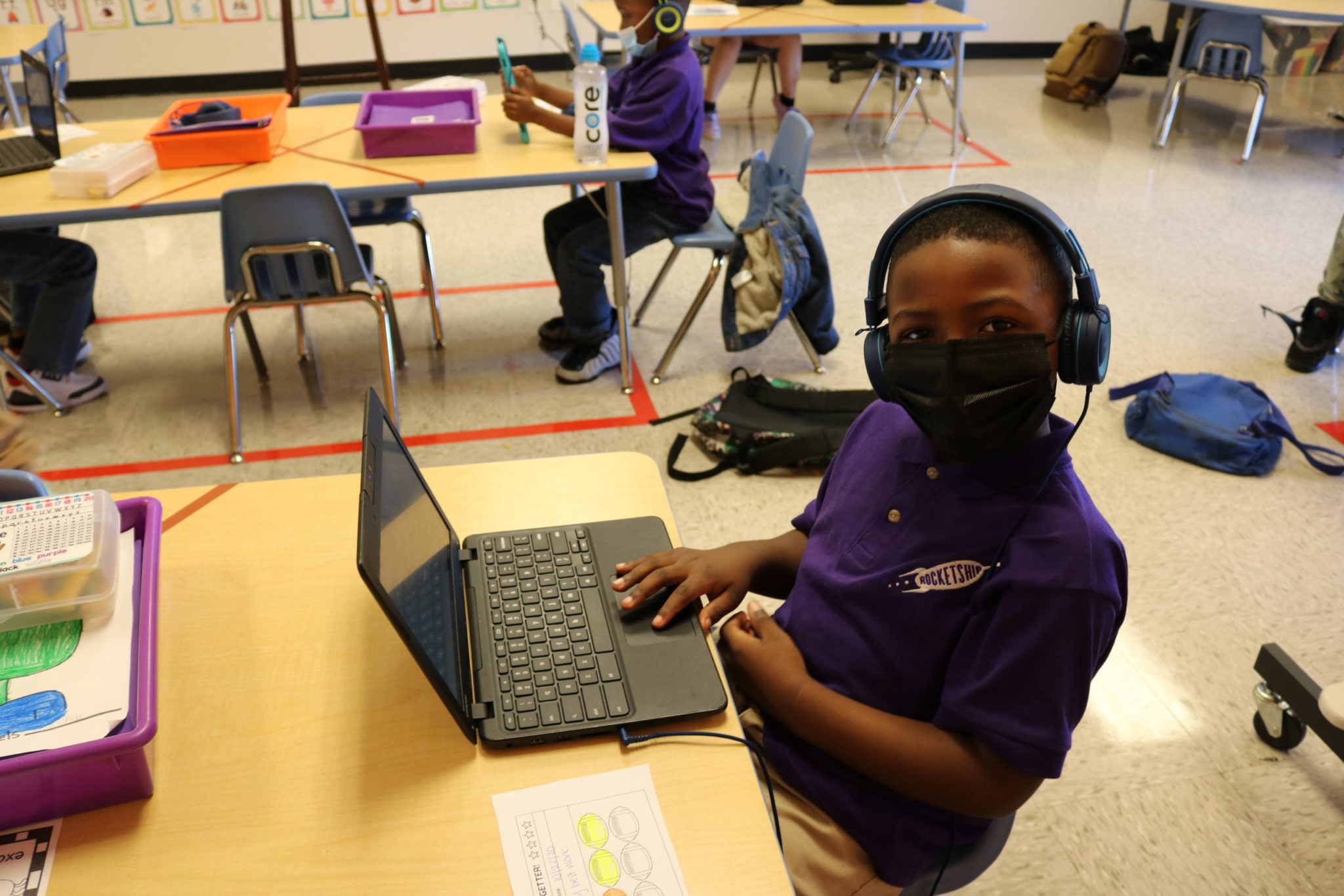
Our Schools in Nashville Transitioned Back into the Classroom. Here’s How the First Two Weeks Went.
By James Cross, 4th Grade Teacher, Rocketship Nashville Northeast Elementary
My ground-floor one-bedroom apartment was never meant to be the home of an elementary school classroom. My 600 square foot apartment doesn’t even have a desk or a table to teach from. When we first went virtual, I bought a matte black patio chair that best aligned to my mid-century modern living room aesthetic and used the back of my couch as a surface to set my computer on. This wasn’t ideal, but I quickly learned that a classroom, however, doesn’t ascribe to a binary, a classroom exists on a spectrum.
Virtual teaching was stressful, new, frustrating, beautiful, and a burden that will plague us for years to come. My students learned though. Contrary to popular belief, learning didn’t stop. In fact, we learned resilience and grit and unapologetically proved that virtual learning is simply learning.
With that said, when I was allowed to reunite with my students in the building, I immediately jumped at the opportunity. Truthfully, I had reached a point in November where I started to accept that those empty desks and unread books back in our barren school building would simply continue to collect dust. Flash forward to March, as we are fast approaching the first anniversary since my school closed to keep us all safe during the onset of the 2020 global pandemic, and we are back in the building.
I’d like to share with you my experience over the first two weeks back. My school is still learning and so am I. We aren’t perfect, but we are safe.
New safety guidelines dictate a good chunk of our normal classroom autonomy.
The huge area rug with the colored squares where we would read books and share in robust conversations with each other is gone. Our desks that were once zip-tied into table groups to promote group learning and community are now individually spaced out and a bright red square made from tape reminds us where their solitary home is. The walls that served as a testament to our learning and a museum of our greatest accomplishments now look similar to the walls of our now bare.
I quickly accepted that my classroom wasn’t going to be featured in a magazine this year (it never has, but call me a dreamer). Instead, I decided to focus on what my students immediately needed and now I can add to it when needed. This is the year that less certainly is more. While our classroom aesthetic might be a little less Pinterest perfect this year, love, joy, and learning transcend the missing rug and grouped tables.
Having an organized system helped me and my students’ families adjust to the new hybrid schedules.
The new school schedule is far from ideal. For our school, some students come on Monday and Tuesday, some are in-person on Wednesday and Thursday, some are still 100% virtual, some stay for tutoring after the school day. We’re all still trying to make sense of the new schedules. My role, as an educator, is to help my students and families make sense of this constantly evolving situation. I didn’t want to rely on school-wide calls and the hope that my students’ families would see the school’s social media post. I decided to own the responsibility of keeping my student’s families informed.
I fully embraced my role as a potential telemarketer and I relabeled each family contact in my phone with either an “a” or a “b” to keep track of their in-person schedule, or a “v” if they were staying virtual. Now, I am still able to provide the communication that families need to know, but I can swiftly target who needs what. I’m responsible for 62 students and being intentional about how I communicate with families has made this transition back extremely efficient. I know this sounds simple, but it has been vital to returning in-person.
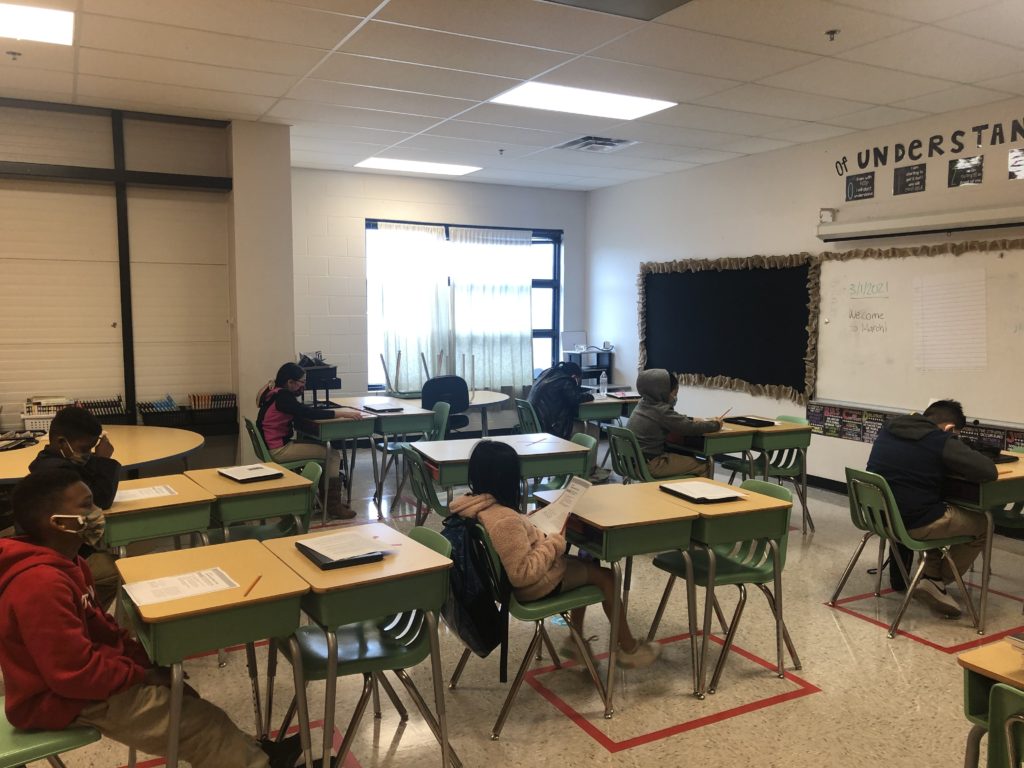
We started with a schedule of essentials students missed and needed.
Teachers are master planners. We routinely take a set of standards and end-of-year goals and miraculously construct a yearly plan that integrates everything our students need to know. It’s never easy, but it starts to become routine. I wanted to equivalate the opportunity to teach in-person again with what I’ve always done. I wanted to prepare a read-aloud, a writing block, close reading, guided reading, centers, and a language block for when I returned. The routine of teaching in-person sounded very comfortable, but it wasn’t what my students needed.
I chose to start slow. Here’s how my days go so far:
- We take a little bit longer than normal to eat breakfast. This ensures that we are following all safety protocols.
- Then we jump into a community meeting where we discuss what is going on with each of us emotionally and set our intentions for the day.
- Next, we move into a writing block. We write every day because the one thing virtual learning couldn’t replicate was the bond of taking pencil to paper.
- After writing, we work through a reading passage and break down some comprehension questions.
- We finish our reading block with a quick language practice.
- Additional time is spent diving into a good book or getting to collaborate on some partner work.
Our block, or what we do each day, will eventually grow, but for now, small steps are working just fine. Education isn’t about drilling knowledge, it’s creating learning opportunities big and small.
My grade-level teachers and I decided to partner to find new ways to personalize instruction.
I still have a lot of areas to get better at when it comes to being back in the physical classroom. We have students of all academic levels who opted to return in-person. You will always find me advocating for inclusive groups, but I know that I need to figure out how to better personalize and differentiate my instruction. I’m planning to partner with my teammates to create a shared grade level plan to accomplish this.
Returning to teach in the school building has left me with some throbbing feet and a full heart. I worry sometimes about what if one of my students contract COVID-19 or what if I somehow do and pass it on to them? I worry about this a lot. I’m also deeply concerned about what emotional toll that this year will have on my students for years to come. I certainly don’t have all the answers, and life is too beautiful to let us know the future. For now, my focus is reminding my students that they are safe at school, that they are loved, and that with time, things will get better.
Published on Tháng ba 18, 2021
Đọc thêm các câu chuyện về: Chưa phân loại.
Trong lớp học

3 Ways to Build Strong Parent-Teacher Connections
By Jeremiah Davis & Mrs. Aqeel, Rocketship Dream Community Prep | May 15, 2025
Ready to level up your relationships with your families this school year? Listen in for tips from an experienced teacher known for building strong bonds with parents!
Đọc thêm ⟩
Làm thế nào để nuôi dưỡng tư duy phát triển trong lớp học
| Ngày 10 tháng 4 năm 2025
Học cách nuôi dưỡng sự phản chiếu, đón nhận thử thách và thúc đẩy tính kiên trì ở bản thân bạn và học sinh của bạn.
Đọc thêm ⟩
Làm thế nào để cải thiện văn hóa trường học
Jeremiah Davis, Trợ lý chuyên môn, Rocketship Dream Community Prep | Ngày 3 tháng 3 năm 2025
Sẵn sàng nâng cao tinh thần ở trường của bạn? Hãy lồng ghép chín lễ kỷ niệm này vào năm học của bạn!
Đọc thêm ⟩
Làm thế nào để huấn luyện trong trường học cải thiện kết quả
Trường công lập Rockesthip | Ngày 4 tháng 2 năm 2025
Tìm hiểu cách huấn luyện trực tiếp và các buổi phản hồi hàng tuần có thể giúp giáo viên của bạn cảm thấy được hỗ trợ nhiều hơn trong suốt cả năm!
Đọc thêm ⟩
Lời khuyên cho giáo viên năm nhất về hội nghị phụ huynh
Jeremiah Davis, Trợ lý chuyên môn, Rocketship Dream Community Prep | Ngày 6 tháng 1 năm 2025
Bạn đang tìm kiếm mẹo hay nhất cho hội nghị phụ huynh? Hãy chuẩn bị với lời khuyên từ các nhà giáo dục của chúng tôi.
Đọc thêm ⟩
Giáo viên năm nhất? Dưới đây là năm lỗi cần tránh.
Jeremiah Davis, Trợ lý chuyên môn, Rocketship Dream Community Prep | Ngày 1 tháng 11 năm 2024
Xem những sai lầm mà hầu hết giáo viên năm nhất mắc phải và cách bạn có thể tiến bộ trong năm học này với một số mẹo đơn giản từ một đồng nghiệp giáo viên.
Đọc thêm ⟩
3 Hệ thống lớp học mà giáo viên mới thề sẽ tuân thủ
Trường công Rocketship | Ngày 30 tháng 9 năm 2024
Với tư cách là một giáo viên năm nhất, việc thiết lập một môi trường lớp học suôn sẻ và hiệu quả có thể khiến bạn cảm thấy hơi choáng ngợp. May mắn thay, những chiến lược đơn giản này có thể giúp ích rất nhiều.
Đọc thêm ⟩
Sự cộng tác giữa các giáo viên có thể mang lại lợi ích gì cho lớp học của bạn
Có sự góp mặt của Alejandra Chavez, Chuyên gia giáo dục tại Trường tiểu học Rocketship Mosaic | Ngày 10 tháng 6 năm 2024
Hãy lắng nghe cô Aly chia sẻ về cách một nhóm giáo viên nhỏ có thể tạo nên sự khác biệt lớn trong kết quả học tập của học sinh thông qua việc lập kế hoạch chu đáo, hợp tác tập trung và các điều chỉnh được cá nhân hóa. Cô Aly là một trong những giáo viên có thành tích cao nhất của chúng tôi tại California trong năm học 23-24.
Đọc thêm ⟩
Hỗ trợ phụ huynh của học sinh đa ngôn ngữ trong các cuộc họp gia đình/giáo viên
Emma Volpe, Học viện Rocketship United | Ngày 1 tháng 6 năm 2022
Nhận được thông tin chi tiết sâu sắc về cách tạo ra môi trường hội nghị gia đình - giáo viên toàn diện hơn.
Đọc thêm ⟩
5 cách để củng cố mối quan hệ trong lớp học
James Cross, Trợ lý Hiệu trưởng, Trường Tiểu học Rocketship Nashville Northeast | Ngày 20 tháng 2 năm 2022
Kỷ nguyên giáo dục mới đòi hỏi một cấp độ kết nối mới. Sau đây là một số mẹo chính để củng cố mối quan hệ trong lớp học của bạn trong năm học này.
Đọc thêm ⟩
5 cách lãnh đạo nhà trường có thể hướng dẫn và hỗ trợ giáo viên
Eesir Kaur, Giám đốc Phát triển Chuyên môn | Ngày 15 tháng 10 năm 2020
Bạn có phải là một nhà lãnh đạo trường học đang muốn hướng dẫn giáo viên của mình hiệu quả hơn không? Sau đây là những gì hiệu quả với chúng tôi.
Đọc thêm ⟩
 Tiếng Việt
  English
  Español de México