

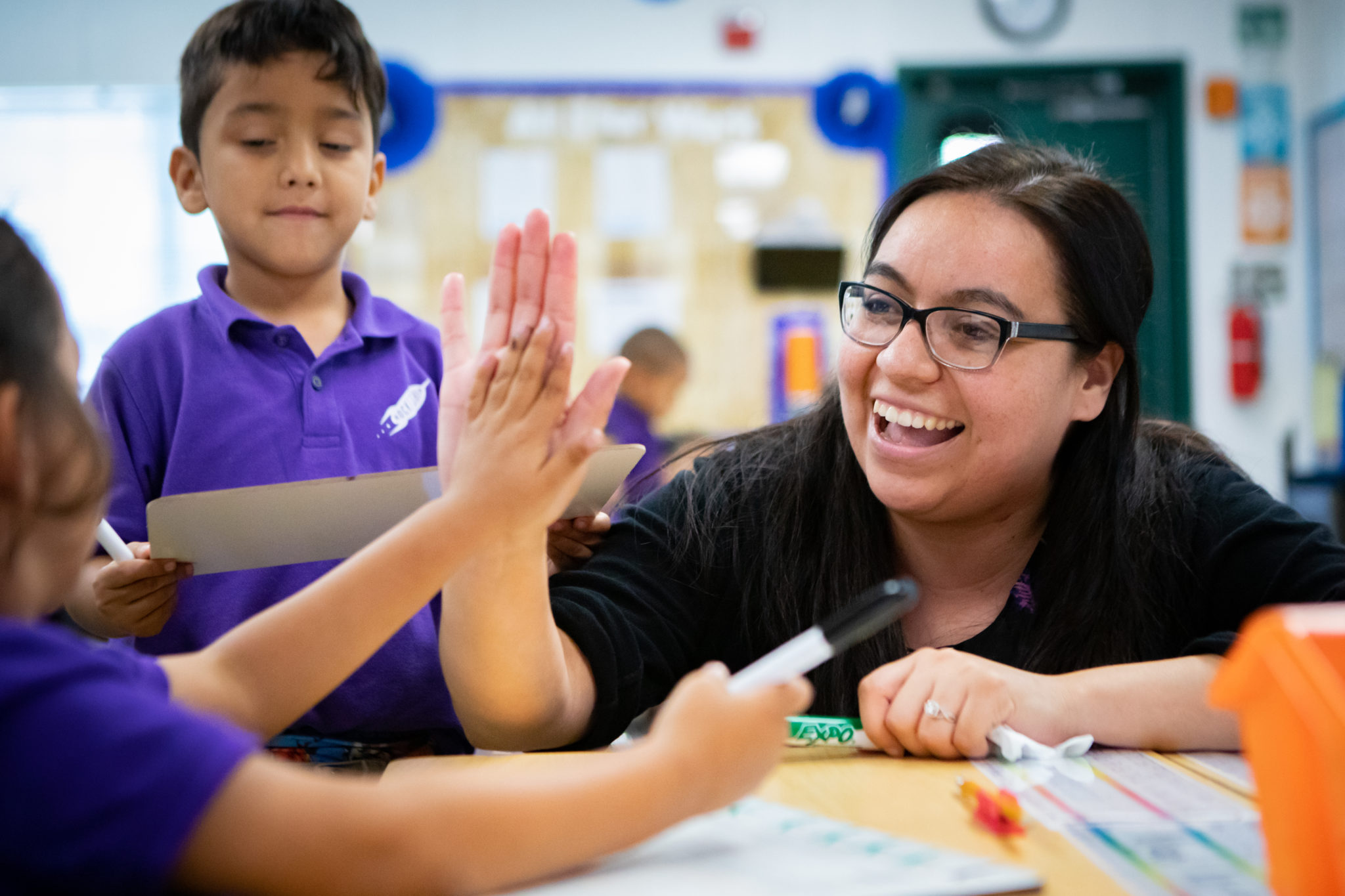
What Makes a Strong Culturally-Responsive Pedagogy
Whether it’s your first year teaching elementary school or your first time teaching at Rocketship, you may be wondering what key things you need to know to start strong on day one. Before you know what you’re going to teach, you need to know how you’re going to teach it – the theory and practice of educating, otherwise known as pedagogy.
At Rocketship Public Schools, we’ve built our curriculum and school culture around a culturally-responsive pedagogy. This means that our curriculum designers, teachers, and leaders are all consciously aware of the different identities they inhabit, the identities and experiences their students bring into the classroom, and work to honor and recognize the intersection of those experiences through the curriculum.
Culturally Responsive Pedagogy/Teaching (often utilizing the acronym CRT) is not only a critical examination of what is being taught but also a deeper exploration of how that content is presented for students. This particular method is effective because it honors students’ experiences and identities, deconstructs stereotypes, and the negative impacts of schooling on traditionally underrepresented groups. It also creates an environment that is both academically and culturally rich and shows students that you can intersect strong, rigorous academic work with cultural values.
If you’re teaching at a school that has a similar approach, follow along to discover the key pillars of a culturally responsive pedagogy and what this looks like in the classroom.
1. Teach With Students At The Center
Giving students choices and agency in their academic work is a key engagement strategy, and allows the teacher, regardless of age, to serve as a “facilitator” for student learning. Giving choice and serving as a guide to course-correct as needed puts the mental “heavy lifting” on the student, and reinforces a rigorous application of course content. Watch this video to see an example.
2. Provide Multiple Opportunities for Practice & Mastery
There is a popular cartoon that depicts different animals lined up in front of a tree with a seated narrator saying: “For a fair selection everybody has to take the same exam: please climb that tree.” While the monkey is smiling at that type of exam, the goldfish and elephant are drawn with mouth-agape astonishment. In today’s educational climate, our students are often exposed to the exact same methods of learning and assessment, but we know they have incredibly diverse strengths and experiences. Think about the multiple ways to assess learning and mastery in your classroom, and see how different techniques can bring out different skills in your students.
3. Examine Your Curriculum
Taking the time to work with curriculum developers and think through the dynamics of pedagogy, representation, and relevance are the collective responsibilities of all educators. Giving students chances to see themselves in their learning and derive meaning from complex tasks that are thought-provoking are hallmarks of great teaching. When teachers focus on the students’ personal experiences, learners are able to make connections between their own lives and academic worlds. Watch this video for an example.
4. Partner With Parents
As educators, forming deep connections with parents and the broader community can have many positive effects. It can engender trust, improve communication, and result in higher academic achievement for students. At Rocketship, we pride ourselves on the strong bond we form with families, and we provide ample opportunities for our families to collaborate and directly participate in their child’s education. To be effective, we understand that the stronger the partnership between home and school, the more connected our students will feel at school. Utilize any and all opportunities to include families in the work of your school and classroom! This can include annual home visits to get to know each family before the year begins. You can also text or email parents when their child excelled in class that day or could use extra support. School administrators can also consider increasing the frequency of parent-teacher conferences to ensure educators are having in-depth touchpoints with each family throughout the year. Watch the below video to hear a parent’s perspective.
5. Communicate High Expectations
In research conducted by Linda-Darling Hammond (2001), considered by many to be one of the foremost authorities on Culturally Responsive Pedagogy, she finds that students of color are not only given inadequate and unequal resources, but the actual quality of the education they receive is not as rigorous. In teaching students, it is critically important to communicate the idea that all students can be successful, and be super clear and proactive in communicating your goals for students. In both short-term and long-term settings, being thoughtful about the way you communicate and offering specific guidance for tasks and goals communicates the high bar you are setting in your classroom. Watch this video for an example.
Source(s):
Smedley BD, Stith AY, Colburn L, et al.; Institute of Medicine (US). The Right Thing to Do, The Smart Thing to Do: Enhancing Diversity in the Health Professions: Summary of the Symposium on Diversity in Health Professions in Honor of Herbert W.Nickens, M.D.. Washington (DC): National Academies Press (US); 2001. Inequality in Teaching and Schooling: How Opportunity Is Rationed to Students of Color in America.
Published on septiembre 26, 2020
Lea más historias sobre: Sin categoría.
En el aula

3 Ways to Build Strong Parent-Teacher Connections
By Jeremiah Davis & Mrs. Aqeel, Rocketship Dream Community Prep | May 15, 2025
Ready to level up your relationships with your families this school year? Listen in for tips from an experienced teacher known for building strong bonds with parents!
Leer más ⟩
Cómo fomentar una mentalidad de crecimiento en el aula
| 10 de abril de 2025
Aprenda a cultivar la reflexión, aceptar los retos y fomentar la perseverancia en usted mismo y en sus alumnos.
Leer más ⟩
Cómo mejorar la cultura escolar
Jeremiah Davis, Paraprofesional, Rocketship Dream Community Prep | 3 de marzo de 2025
¿Listo para elevar la moral en tu colegio? Incorpore estas nueve celebraciones a su curso escolar.
Leer más ⟩
Cómo el coaching en las escuelas mejora los resultados
Escuelas Públicas de Rockesthip | Feb 4, 2025
Descubra cómo el coaching en directo y las sesiones semanales de feedback pueden ayudar a sus profesores a sentirse más respaldados durante todo el año.
Leer más ⟩
Conferencia de padres: consejos para profesores noveles
Jeremiah Davis, Paraprofesional, Rocketship Dream Community Prep | 6 de enero de 2025
¿Busca consejos para la conferencia de padres? Prepárese con los consejos de nuestros educadores.
Leer más ⟩
¿Primer año como profesor? Aquí tienes cinco errores que debes evitar.
Jeremiah Davis, Paraprofesional, Rocketship Dream Community Prep | 1 de noviembre de 2024
Descubre qué errores comete la mayoría de los profesores primerizos y cómo puedes salir adelante este curso escolar con algunos sencillos consejos de un colega educador.
Leer más ⟩
3 sistemas de aula por los que juran los nuevos profesores
Escuelas Públicas Rocketship | 30 de septiembre de 2024
Como profesor primerizo, establecer un entorno de clase fluido y productivo puede resultar un poco abrumador. Por suerte, estas sencillas estrategias pueden ayudar mucho.
Leer más ⟩
Cómo la colaboración entre profesores puede beneficiar a su clase
Presentación de Alejandra Chávez, especialista en educación de la escuela primaria Rocketship Mosaic | 10 de junio de 2024
Escuche a la Sra. Aly hablar de cómo un pequeño equipo de educadores puede marcar una gran diferencia en los resultados de los estudiantes mediante una planificación cuidadosa, una colaboración centrada y adaptaciones personalizadas. La Sra. Aly fue una de nuestras educadoras con mejores resultados en California en el curso 23-24.
Leer más ⟩
Apoyo a los padres de alumnos multilingües en las reuniones familia-profesor
Emma Volpe, Academia Rocketship United | 1 de junio de 2022
Obtenga reflexiones sobre cómo crear un entorno más integrador para las reuniones entre familias y profesores.
Leer más ⟩
5 maneras de fortalecer las relaciones en el aula
James Cross, Subdirector, Rocketship Nashville Northeast Elementary | 20 de febrero de 2022
La nueva era de la educación exige un nuevo nivel de conexión. Aquí tienes algunos consejos clave para fortalecer las relaciones en tu aula este curso escolar.
Leer más ⟩
5 formas en que los directores de centro pueden orientar y apoyar a los profesores
Eesir Kaur, Directora de Desarrollo Profesional | 15 de octubre de 2020
¿Es usted el director de un centro de enseñanza y quiere formar a sus profesores de forma más eficaz? Esto es lo que nos funciona a nosotros.
Leer más ⟩
 Español de México
  English
  Tiếng Việt